NDA basics, mutual vs one way and what to check before you sign
October 12, 2026
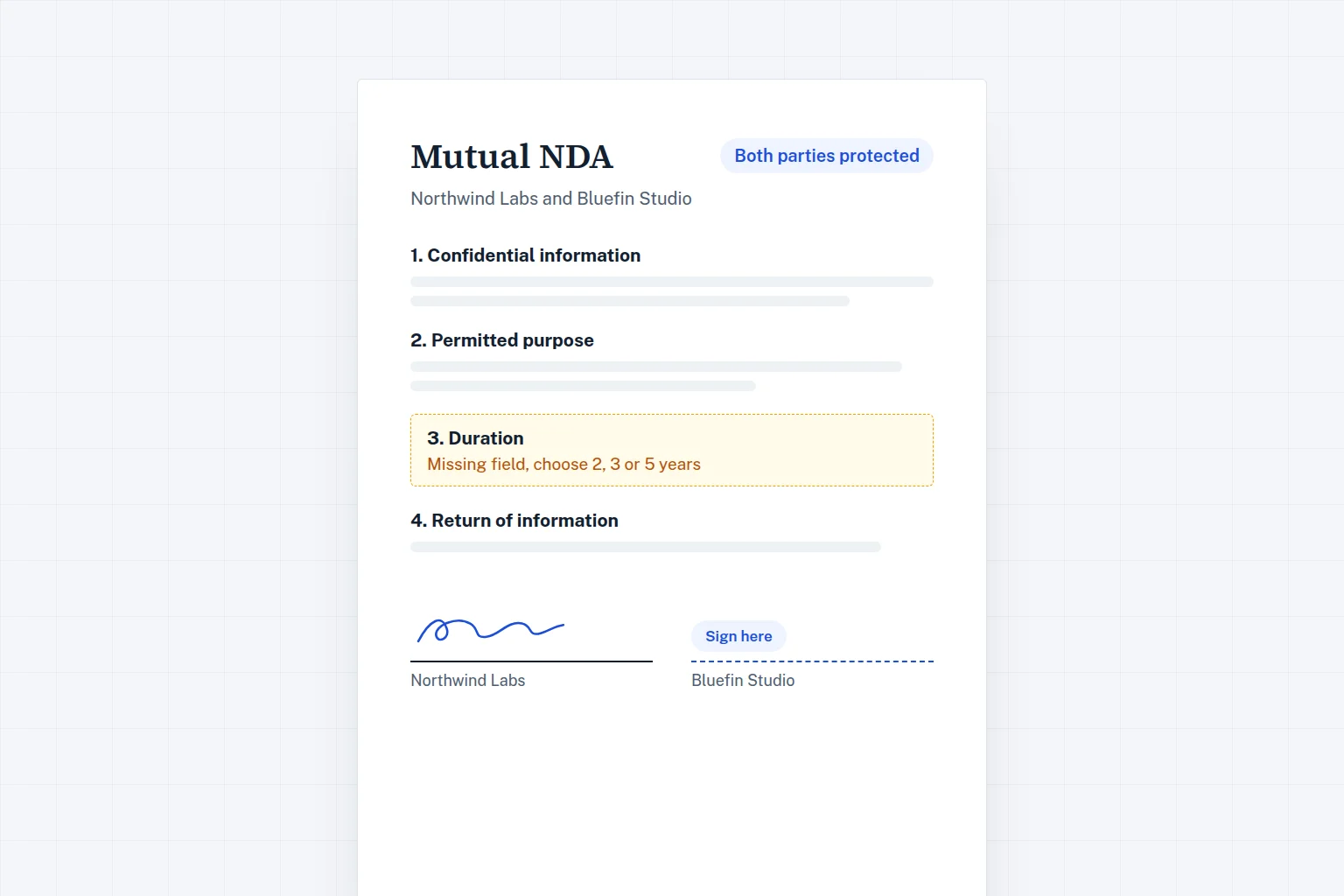
A non disclosure agreement (NDA) is a contract in which one or both parties promise to keep certain information confidential and use it only for an agreed purpose. Use a mutual NDA when both sides will share sensitive information, and a one way NDA when only one side will. Before you sign, check how confidential information is defined, what is excluded, how long the obligations last and whether anything unrelated to confidentiality has been added.
NDAs are among the most common agreements a business signs, and because they look routine they are often signed without being read. Most are fine. Some contain terms that last forever, restrict hiring or quietly weaken your protection. This guide explains the parts that matter so you can tell the difference quickly.
This article is general information, not legal advice. For advice on a specific agreement, speak to a qualified lawyer in the relevant jurisdiction.
What an NDA does
An NDA creates a legal duty to keep information secret that would not otherwise exist, or that would be hard to prove. It is typically signed before a sales conversation that involves pricing or technical details, before due diligence on an investment or acquisition, before sharing product plans with a potential partner, or when bringing in a contractor who will see internal systems.
An NDA does not make information secret by itself. If you share something widely, or the other side learns it independently, the agreement usually stops protecting it. It also does not replace other protections such as patents or trademarks.
Mutual and one way NDAs
| Type | Who is protected | Typical use |
|---|---|---|
| One way (unilateral) | Only the disclosing party. The receiving party takes on the obligations. | Hiring a contractor, sharing a pitch with a potential investor who will not share anything back, onboarding a vendor that will see your data. |
| Mutual (bilateral) | Both parties. Each is a discloser and a recipient. | Partnership talks, technical evaluations, acquisitions, joint product work. |
A useful test is to ask who will actually hand over sensitive information. If the answer is both sides, a mutual NDA is fairer and usually faster to agree, because neither party has to argue that the terms only bind the other. If you are the only one disclosing, a one way NDA keeps the document shorter and puts the obligations where they belong.
The clauses to read before you sign
Definition of confidential information
This clause decides what is protected. Some NDAs list categories, such as financial data, customer lists, source code and product plans. Others protect anything disclosed, sometimes only if it is marked confidential. A marking requirement is convenient for the recipient but risky for the discloser, because verbal or unmarked information may fall outside the agreement. A reasonable middle ground covers marked information plus anything a reasonable person would understand to be confidential.
Exclusions
Standard exclusions remove information that is already public, that the recipient already knew, that the recipient develops independently, or that it receives lawfully from a third party. These exclusions are normal and fair. Check that they are present and that the burden of proving them sits with the recipient.
Permitted use and purpose
A good NDA limits use of the information to a stated purpose, for example "evaluating a possible commercial relationship between the parties". Without a purpose clause, the recipient may only be prevented from disclosing the information, not from using it.
Who can receive it
Most NDAs allow disclosure to employees, advisers and sometimes affiliates who need to know the information for the purpose, provided they are bound by similar duties. Check whether the recipient is responsible for breaches by those people.
Duration
There are usually two periods: how long the parties will exchange information, and how long the confidentiality obligation lasts after that. Two to five years is common for ordinary business information. Trade secrets are often protected for as long as they remain secret.
Return or destruction
At the end of the relationship, or on request, the recipient should return or destroy the information. Reasonable drafts allow the recipient to keep copies required by law or held in automatic backups, as long as those copies stay confidential.
Remedies
Many NDAs state that a breach may cause harm that money cannot fix, so the discloser can ask a court for an injunction. Watch for fixed penalty amounts or uncapped indemnities, which are less common in a standard NDA and deserve a closer look.
Governing law and jurisdiction
This sets which law applies and where disputes are heard. A distant jurisdiction can make the agreement expensive to enforce or defend, so it is worth checking even on a short document.
Common pitfalls
- Definitions that are too broad. "All information of any kind" can capture things you already know, which makes the NDA hard to comply with and can be used against you later.
- Perpetual terms for ordinary information. Confidentiality with no end date is reasonable for trade secrets but unusual for general business information. A fixed term is easier to track and to honour.
- Residuals clauses. These let the recipient use information retained in the unaided memory of its staff. For a discloser, a residuals clause can undo much of the protection. If you see one, consider removing it or narrowing it.
- Non solicit terms hidden in the NDA. A clause that stops you hiring the other side's employees, or contacting its customers, is not about confidentiality. It may be acceptable, but it should be a conscious decision, not something signed by accident.
- One way terms in a two way relationship. If you will also share information, a one way NDA leaves your side unprotected.
- Missing purpose limits. Without them, the other party may be free to use what it learns.
When to involve a lawyer
A standard mutual NDA for an early commercial conversation is often fine to sign after a careful read. Bring in a lawyer when the NDA covers trade secrets, source code or unreleased products, when it is part of an investment, acquisition or joint development, when it includes non solicit, non compete or exclusivity terms, when it involves personal data or regulated information, or when the other party refuses to change terms that worry you.
How to draft and sign an NDA quickly
- Start from a template. A clean mutual or one way template gives you the standard structure. Our template library includes both.
- Describe the deal in one sentence. With the NDA generator, you write something like "mutual NDA with Acme for evaluating a data integration partnership, three year term, New York law" and get a structured draft with the parties, purpose and term filled in.
- Fill the gaps. Signee flags missing fields, such as the counterparty's signer or the governing law, before you send.
- Send for signature. Set the signing order and let automatic reminders follow up. Simple electronic signatures with an audit trail are valid for NDAs in most situations under ESIGN, UETA and eIDAS. Our guide to ESIGN, UETA and eIDAS explains the details, and the electronic signature page shows how signing works.
- Track the end date. Signed NDAs are stored in the repository, with the term and return obligations extracted, so you know when confidentiality ends.
NDA drafting is included on every plan, starting with Starter at 49 USD a month, or 24 USD a month billed yearly, for 3 users and 30 documents a month.
Quick answers
Is an NDA signed electronically enforceable
In most cases, yes. Electronic signature laws such as ESIGN and UETA in the United States and eIDAS in the EU give simple electronic signatures legal effect for ordinary commercial contracts like NDAs.
Should a startup always ask for a mutual NDA
Not always. If only you are sharing information, a one way NDA in your favour is appropriate. If both sides share, mutual terms are usually easier to agree.
Are generated NDAs legal advice
No. A generated NDA is a template and drafting assistance. Review it before sending, and ask a lawyer when the stakes or the terms are unusual.