ESIGN, UETA and eIDAS explained for business contracts
October 10, 2026
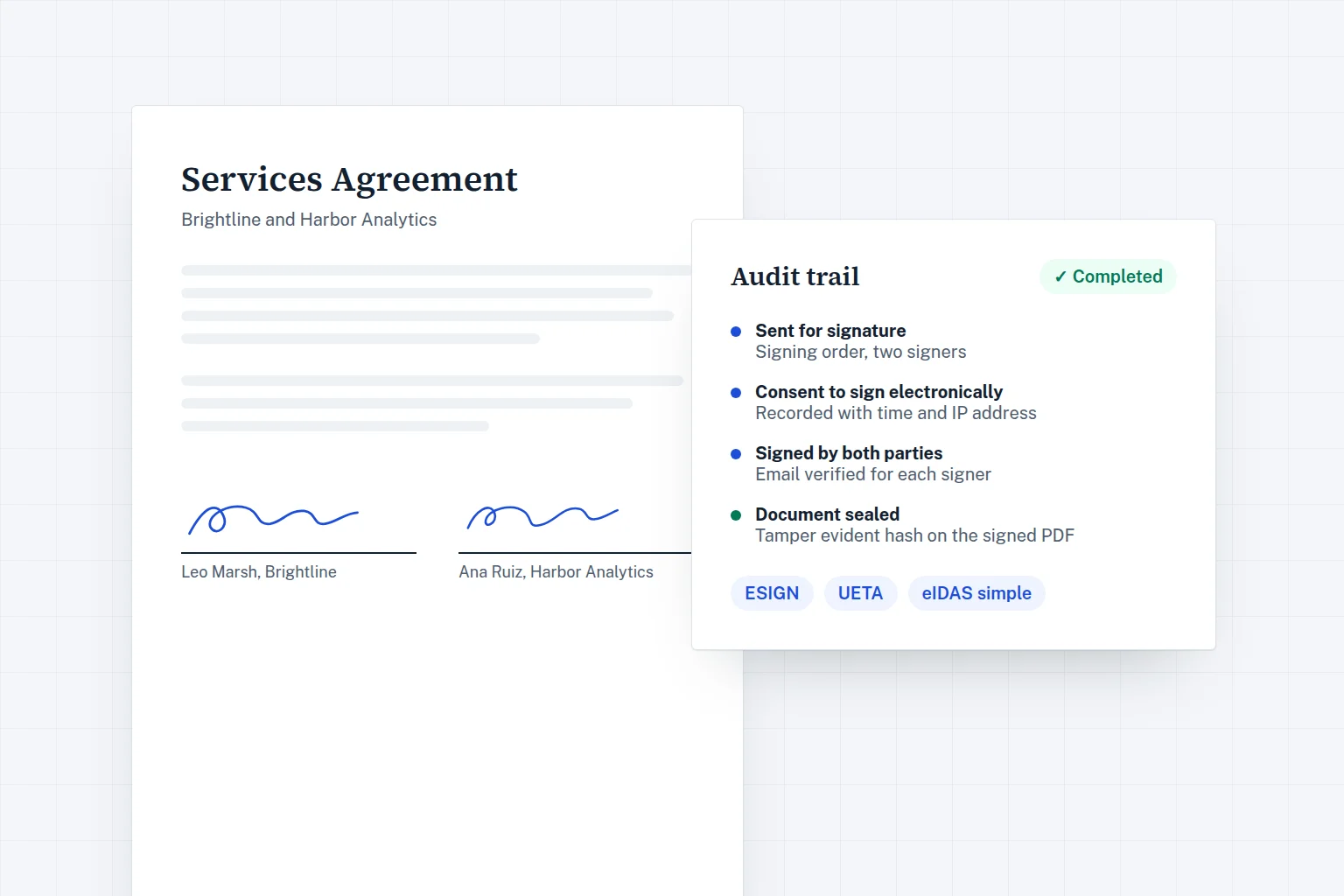
Yes, in most business situations an electronic signature is legally binding. In the United States the ESIGN Act and UETA give it the same effect as ink, and in the EU the eIDAS Regulation does the same, with a few document types excluded.
That is the short answer, and it is the one most people need before they send an order form or a services agreement. The longer answer matters when a contract is disputed, when the other party sits in another country, or when the document belongs to one of the categories the law carves out. This guide walks through the three frameworks that cover most commercial deals, what they actually require, where they stop, and what a signing tool has to record so that a signature holds up later.
What the law means by an electronic signature
None of these laws require a drawn squiggle. UETA defines an electronic signature as an electronic sound, symbol or process attached to or logically associated with a record and executed or adopted by a person with the intent to sign the record. ESIGN uses almost the same wording. eIDAS describes it as data in electronic form attached to or logically associated with other data and used by the signatory to sign.
So typing your name, clicking a clearly labelled "Sign" button, or drawing on a touchscreen can all count. What the definitions share is not the technology but two ideas.
- Intent. The person meant to sign this specific document, not just to open it or scroll through it.
- Association. The signature is tied to the record it signs, so you can show which version of which document was signed.
Everything else, from audit trails to email verification, exists to prove those two things if someone later says "I never signed that" or "that is not what I signed".
The ESIGN Act in the United States
The Electronic Signatures in Global and National Commerce Act became federal law in 2000. Its core rule is simple. A signature, contract or other record relating to a transaction in interstate or foreign commerce may not be denied legal effect, validity or enforceability solely because it is in electronic form.
Two details are easy to miss.
Consumer consent
When a law requires that information be given to a consumer in writing, ESIGN lets you deliver it electronically only if the consumer has affirmatively consented, has been told about their right to receive paper, how to withdraw consent, and the hardware and software needed to access the records. Business to business deals do not carry this extra step, but a lot of signing tools apply a consent screen to every signer anyway, because it costs little and removes an argument later.
Record retention
If a law requires a contract to be retained, an electronic record satisfies that only if it accurately reflects the information and remains accessible to the people entitled to it, in a form that can be accurately reproduced. In practice that means keeping the final signed file, not a draft, and being able to hand over a copy years later.
UETA and the state layer
The Uniform Electronic Transactions Act is a model law published in 1999. States adopt it into their own statutes, and almost all of them have. New York is the well known exception and relies on its own Electronic Signatures and Records Act, which reaches a similar result for most commercial documents.
UETA adds one principle that matters for day to day contracting. It applies only to transactions where each party has agreed to conduct the transaction by electronic means, and that agreement is judged from the context and surrounding circumstances, including the parties' conduct. If a customer receives your agreement by email, opens a signing link and signs, the context usually shows that agreement. If someone has said in writing that they only accept paper, it does not.
ESIGN and UETA sit side by side. Where a state has adopted UETA in its standard form, ESIGN largely defers to the state law. For a business sending sales contracts across state lines, the practical effect is the same either way.
What US law excludes
Electronic signatures are not universal. ESIGN lists documents it does not cover, and state law adds or narrows some of them. The main exclusions are these.
- Wills, codicils and testamentary trusts.
- Family law matters such as adoption and divorce.
- Court orders, notices and official court documents.
- Notices of cancellation or termination of utility services.
- Notices of default, acceleration, repossession, foreclosure or eviction relating to a primary residence.
- Notices of cancellation of health or life insurance.
- Product recall notices that relate to health or safety.
- Documents required to accompany the transport or handling of hazardous materials.
- Most transactions under the Uniform Commercial Code, apart from the sale and lease of goods under Articles 2 and 2A and a few other sections.
Real estate is a common point of confusion. Many purchase agreements and leases are signed electronically every day, but deeds and documents that must be recorded or notarized follow state and county rules, and some still need a wet signature or a remote online notarization process. If a document is going to a recorder's office, check that office's rules before you send it.
eIDAS in the European Union
Regulation (EU) No 910/2014, known as eIDAS, applies directly in every member state and was updated in 2024. It does two things that matter for contracts. First, Article 25 says an electronic signature shall not be denied legal effect and admissibility as evidence in legal proceedings solely because it is electronic or because it does not meet the requirements for a qualified signature. Second, it defines three levels of signature.
| Level | What it requires | Typical use |
|---|---|---|
| Simple electronic signature | Any electronic data used by the signer to sign, such as a typed name or a click to sign with an email verified link | Order forms, NDAs, services agreements, most B2B contracts |
| Advanced electronic signature | Uniquely linked to and capable of identifying the signer, created with data under the signer's sole control, and linked to the document so any later change is detectable | Higher value contracts, HR documents, deals where identity is likely to be questioned |
| Qualified electronic signature | An advanced signature created with a qualified signature creation device and based on a qualified certificate issued by a trust service provider after identity verification | Documents where national law demands a handwritten equivalent, some public sector filings |
Only the qualified level has the automatic legal effect of a handwritten signature across the EU. The other two are valid and admissible, but if a dispute reaches court, the party relying on the signature may have to show how it was created and that it belongs to the signer. That is where evidence quality decides the outcome.
Member states also keep their own form requirements. Some contract types, for example certain property transfers, guarantees given by consumers, or employment documents in a few countries, require a written form that only a qualified signature can satisfy electronically. The United Kingdom kept a near copy of eIDAS after Brexit and, alongside it, an English law tradition that accepts a wide range of electronic signatures for commercial documents.
What makes a signature hold up in practice
Laws say electronic signatures are valid. Disputes are won or lost on evidence. When a signature is challenged, the questions are usually who signed, whether they meant to, and whether the document changed afterwards. A well built signing process answers each of them.
- Signer authentication. Each signer gets a unique link sent to their own email address, so access proves control of that inbox. For higher risk documents you can add a one time code.
- Consent to electronic records. The signer agrees to do business electronically before the document opens.
- Clear intent. A visible signature field and a button that says what it does, not a hidden checkbox.
- A tamper evident record. The final file is sealed with a hash, so any later edit shows up.
- An audit trail. Every event is logged with time, email and IP address, from sending and viewing to signing and completion, and attached as a certificate.
- A copy for every party. All signers receive the completed document, which also helps meet retention rules.
Where Signee fits
Signee provides electronic signatures with consent to electronic records, signer authentication by email link, signing order, a tamper evident audit trail and a completion certificate. It is designed for the ESIGN Act and UETA in the US and for simple and advanced electronic signatures under eIDAS. It does not issue qualified electronic signatures, so documents that legally require a QES, and the excluded categories listed above, should be signed another way.
For the full breakdown of how the audit trail is built and stored, see our page on whether electronic signatures are legally binding and the security overview. If you are comparing tools for sales and services contracts, the electronic signature software page shows the signing flow from start to finish, and pricing lists what each plan includes.
A quick checklist before you send
- Is the document in an excluded category, or does local law require a qualified or notarized signature for it?
- If any signer is a consumer, does your flow collect consent to electronic records with the required disclosures?
- Does each signer receive their own link at an email address you can tie to them?
- Will the final file be sealed and come with an audit certificate?
- Do you keep the signed copy where your team can find it when the renewal or a dispute comes around?
If you can tick all five, you are in a strong position for the vast majority of commercial agreements.
This article is general information, not legal advice. Signee is not a law firm. Rules differ by country, state and document type, so ask a qualified lawyer about your specific situation.